- Aug 25, 2025
What About Those Costco Microfiber Towels?
- Michael Mankarious
Quick Take: At $20 for 36, Costco microfiber towels deliver real value. They’re solid for interior surfaces, wheels, and glass, but the sewn edges, 80/20 blend, and lower density make them risky on soft paints (like many Japanese cars). For exterior paint, reserve higher-quality edgeless towels.
Walk into a Costco and you'll find a stack of those big packs of Kirkland Microfiber Towels flying off the shelves. More than a few discussions on various auto detailing discussion boards sing their praises. At $20 for 36 towels, it's a tempting offer. But are they safe for your car? Is the value worth the potential risk of using it on your car's paint?
The Case for Costco Towels
No question getting 36 microfiber towels for $20 is a bargain. Additionally, you can't ignore the Kirkland name on the pack (Costco's esteemed private label brand), which is associated with premium quality and value, and is featured on Costco products ranging from wine to caviar.
Everything's bigger at Costco, and that goes for their microfiber towel packs. Usually, packs come in quantities of 10 and 20. However, at Costco, you get 36 towels, which at $0.55 per towel, puts it in wholesale territory.
The pack states an 80/20 blend at 300 GSM, which indicates the density and quality of the towel. Overall, these are considered good specifications for a general-purpose microfiber towel.
They are good for general tasks. Think interiors, door jambs, wheels, glass, and engine bay. Areas I'm not concerned about scratching.
They're ubiquitous. Besides being used in everyday household chores, these microfiber towels have been seen on the car show circuit, including premier concours events.
Where They Might Fall Short
Let’s do a quick breakdown.
Blend Ratio: The Costco microfiber towels are rated at 300 GSM and are an 80/20 blend. The 80/20 notation refers to the towel fiber composition: 80% polyester and 20% polyamide (nylon). Polyester is made for scrubbing, and the polyamide is the softer component that absorbs liquids. The higher the percentage of polyamide, the gentler the towel. While 80/20 is the baseline standard, it's not ideal when it comes to detailing car paint. 80/20 blends, however, make for a more affordable towel. Higher quality towels like Autofiber’s Mr. Everything Towel is a 70/30 blend.
Density: Consider the GSM (grams per square meter), which indicates the density of the towel.
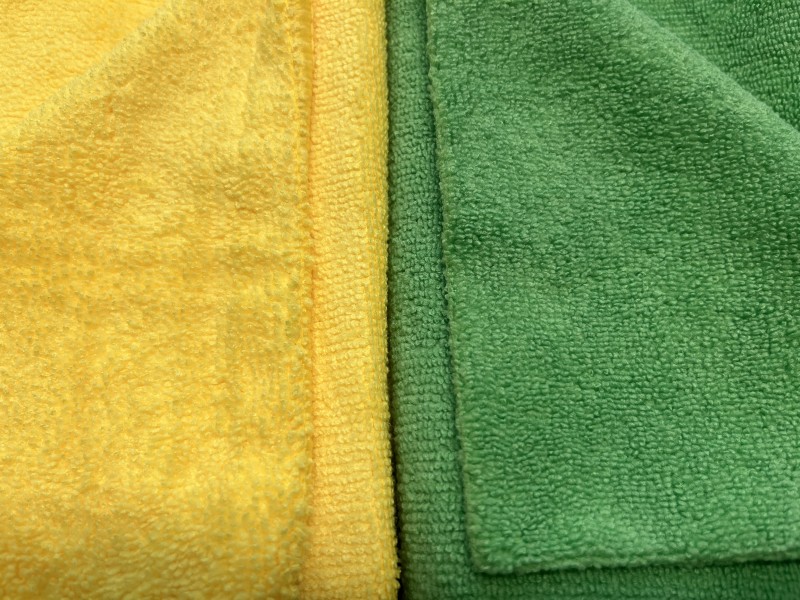
In this close-up, we have the yellow Costco towel (300 GSM) on the left and the green Autofiber Mr. Everything towel (390 GSM) on the right. You can see a difference in consistency of the fibers, with the Autofiber towel being far more consistent in density. A more dense towel is safer on paint.
Edgeless: Costco microfiber has sewn edges. Towels with sewn edges have a higher chance of scratching sensitive paints. More premium towels, like Autofiber towels, are edgeless.
Weight: Both towels are 16x16 inches, but when holding the Costco microfiber towel in one hand and the Autofiber Mr. Everything towel in the other hand, you can feel the difference in density and weight.
Durability: When it comes to durability, Costco microfiber towels may not hold up as well after multiple washes. I prefer to get the most value out of my towels and less environmental waste, so if I can keep my towel longer, a quality towel that lasts dozens of washes would be my preference.
Linting: A shedding Costco microfiber towel was common fifteen years ago when they first became available. They have vastly improved over the last 15 years, and you don't experience this as much today. While lint may not be a big deal for most detailers, if you're leveling ceramic coating or buffing off that nice coat of sealant wax, you can't afford to have any lint whatsoever. Costco has stepped up its game but it’s a guarantee that there will be zero lint with higher quality towels.

When using a premium microfiber towel on car paint (especially dark colored paint), you greatly minimize the potential for scratches due to a softer and higher density fiber count and edgeless design.
Hard vs. Soft Paint and Why It Matters
Car paint in general is very durable, but some have a higher hardness factor than others. Japanese and American brand cars tend towards softer car paint. German brands, on the other hand, use harder paint. Softer paints, as you can guess, scratch more easily. But at the same time, they are easier to polish out. Vice versa for harder paints.
For this reason, towel choice can make a difference and explain the variety of opinions about Costco microfiber. Add to the mix older cars with harder lacquers (pre-1990s), and it might make sense why those with classic cars on the premier concours show circuit have no complaints with Costco microfiber, since their paint doesn't scratch easily.
So, in essence, a Costco towel may be perfectly fine on a BMW, but on a black Lexus, you might notice micro-marring.
Best Use Cases for Costco Towels
I like Costco towels, but it's best to reserve them for cleaning the interior, door jams, wheels, exhausts, glass, and engine bay.
I always reach for the Autofiber Mr. Everything towel for exterior paint, whether I'm buffing off polish, sealant wax, or leveling ceramic coating.
For wiping down details, I'm reaching for either my super-soft Korean microfiber towel, which boasts a whopping 470 GSM and a 70/30 blend, or a Mr. Everything towel.
Don't ditch the Costco towels. Keep them for utility work, while reserving your higher-quality towels for sensitive paint surfaces.
Takeaway
Costco microfiber towels offer real value. For everyday folks, it is a step up from a thin bag of rags and cloth diapers, which are guaranteed to scratch paint.
I don't want you to spend a lot of time meticulously detailing your paint only to discover micro scratches later.
Knowing which towel to use and where is the key to a successful detail routine. Remember, we're creating a system and in that system there's a place for Costco's microfiber towels.
Frequently Asked Questions
Q: Are Costco Kirkland microfiber towels safe for car paint?
Costco Kirkland microfiber towels can be safe for car paint, but it depends on your paint type. They work well on harder paints (like many German cars), but may cause micro-marring on softer paints found in Japanese and American vehicles. The 80/20 blend, 300 GSM density, and sewn edges make them riskier for sensitive paint surfaces. For best results, use edgeless, higher-density towels (70/30 blend, 390+ GSM) on exterior paint, and reserve Costco towels for interiors, wheels, and glass.
Q: How much do Costco microfiber towels cost?
Costco sells their Kirkland microfiber towels for approximately $20 for a 36-pack, which works out to about $0.55 per towel. This wholesale pricing makes them one of the most affordable microfiber options available and represents excellent value for general cleaning tasks.
Q: What is the GSM of Costco microfiber towels?
Costco Kirkland microfiber towels are rated at 300 GSM (grams per square meter) with an 80/20 blend (80% polyester, 20% polyamide). While this is considered baseline for general-purpose microfiber towels, premium detailing towels typically range from 390-470 GSM with a 70/30 blend for safer paint care.
Q: Do Costco microfiber towels scratch paint?
Costco microfiber towels can potentially scratch soft paint due to their sewn edges, lower density (300 GSM), and 80/20 blend ratio. The risk is higher on soft paints like those on black Lexus, Honda, or Toyota vehicles. Harder paints on German cars (BMW, Mercedes, Porsche) are less susceptible. To minimize scratching risk, use edgeless towels with higher GSM ratings specifically designed for automotive paint.
Q: What are Costco microfiber towels best used for?
Costco microfiber towels excel at cleaning car interiors, door jambs, wheels, exhaust tips, glass, and engine bays—areas where scratching isn't a primary concern. They're also great for general household cleaning. However, for exterior paint, buffing polish, leveling ceramic coatings, or wiping sealant wax, invest in premium edgeless towels with higher GSM ratings and 70/30 blends.
Q: Are edgeless microfiber towels better than Costco towels?
Yes, edgeless microfiber towels are safer for car paint than Costco towels. The sewn edges on Costco towels can create micro-scratches on sensitive paint surfaces. Edgeless towels eliminate this risk entirely and typically feature higher GSM ratings (390-470 vs. 300) and better blend ratios (70/30 vs. 80/20), making them the preferred choice for exterior detailing work.
Q: What's the difference between 80/20 and 70/30 microfiber blends?
The numbers refer to the ratio of polyester to polyamide (nylon) in the towel. An 80/20 blend (like Costco towels) contains 80% polyester for scrubbing and 20% polyamide for absorption. A 70/30 blend contains more polyamide, making it softer and gentler on paint. Premium detailing towels use 70/30 blends because the higher polyamide content reduces the risk of scratching delicate automotive finishes.
Q: Do Costco microfiber towels lint?
Costco microfiber towels have significantly improved over the past 15 years and lint much less than earlier versions. However, they may still shed some fibers, which can be problematic when leveling ceramic coatings or buffing sealant wax where zero lint is essential. Premium microfiber towels guarantee lint-free performance for finish-sensitive detailing tasks.
Q: Can you use Costco towels on black cars?
You can use Costco microfiber towels on black cars for interior cleaning, wheels, and glass, but exercise caution on black paint. Dark colors show scratches and micro-marring more easily than light colors. If you have a black car with soft paint (especially Japanese brands), use premium edgeless towels with 390+ GSM and 70/30 blends on the exterior paint to minimize visible swirl marks.
Q: What towels should I use instead of Costco for car detailing?
For exterior paint work, consider premium options like the Autofiber Mr. Everything towel (390 GSM, 70/30 blend, edgeless) or Korean plush microfiber towels (470 GSM, 70/30 blend). These towels offer superior density, softer fibers, and no sewn edges, making them much safer for sensitive automotive paint. Reserve Costco towels for utility work while investing in quality towels for paint-critical tasks.